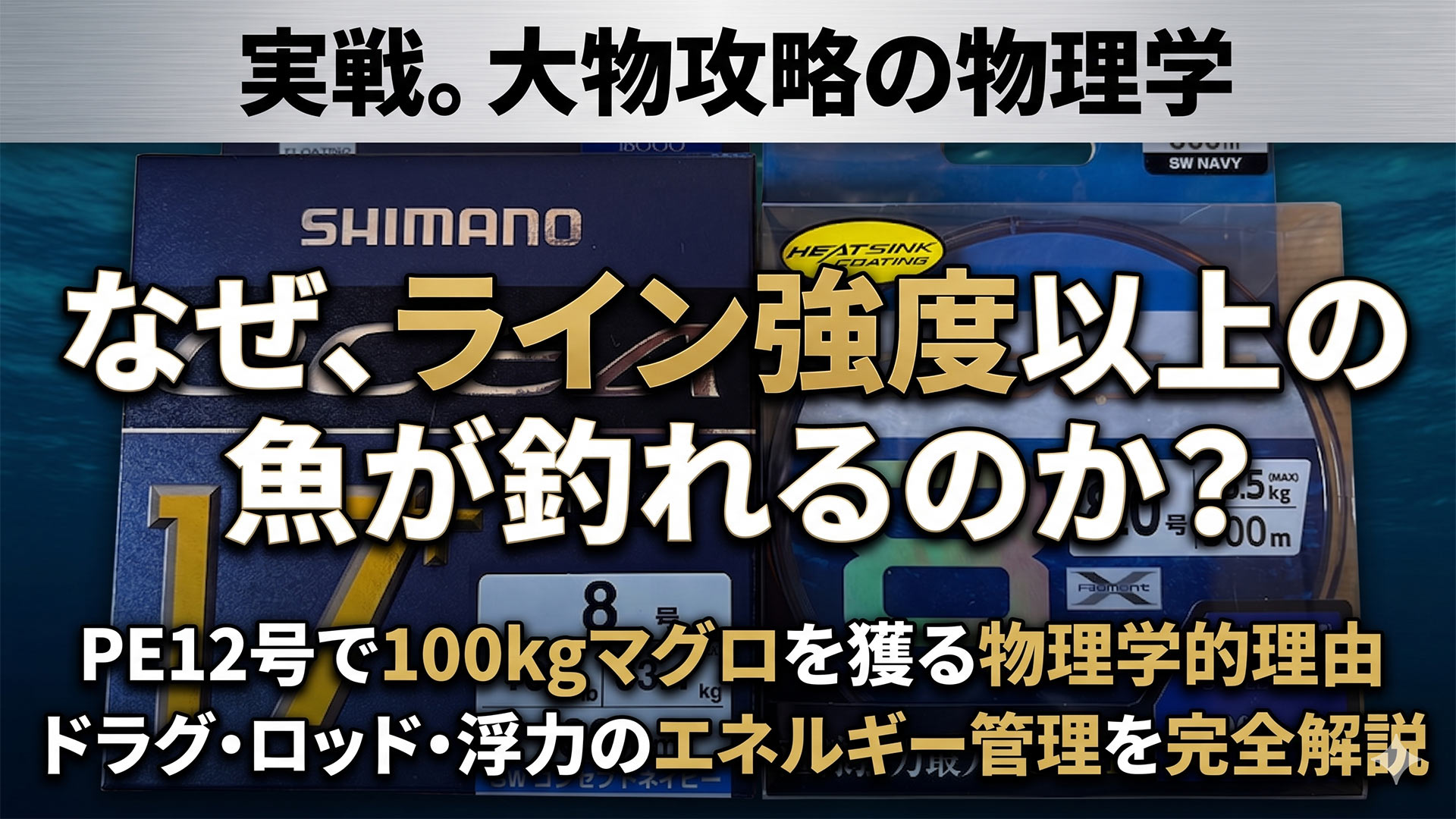
PE #12 line has a maximum breaking strain of about 89.5kg. Yet, we can land bluefin tuna weighing well over 100kg. When you think about it calmly, isn’t it strange how we can land fish heavier than our line strength?
There was a time when I too thought, “Line strength = The maximum weight of the fish you can catch.” I used to believe that PE #1 could only catch fish up to 9kg, and that you needed a line with over 100kg of strength to catch a 100kg tuna. But the reality is entirely different.
In this article, I will explain exactly why we can catch fish that exceed the strength of our line, based on everything I researched and learned through my own experiences.
- 1. What Exactly Does “Line Strength” Mean?
- 2. Three Reasons Your Line Doesn’t Break
- 3. The Force a Fish Applies is Not Its “Weight”
- 4. Then Why Do Lines Break?
- 5. Case Study: How PE #12 (89.5kg) Lands a 100kg Tuna
- 6. How This Knowledge Upgrades Your Actual Fishing
- 7. Conclusion: Line Strength is a “Safety Margin,” Not a “Limit”
1. What Exactly Does “Line Strength” Mean?
[Answer]
Line strength (maximum breaking strain) is simply the force required to break the line when both ends are slowly pulled apart in a straight line. In actual fishing, this force is rarely applied constantly. Because the drag, rod flex, and water buoyancy all work together, we can catch fish much heavier than the line’s rated strength.
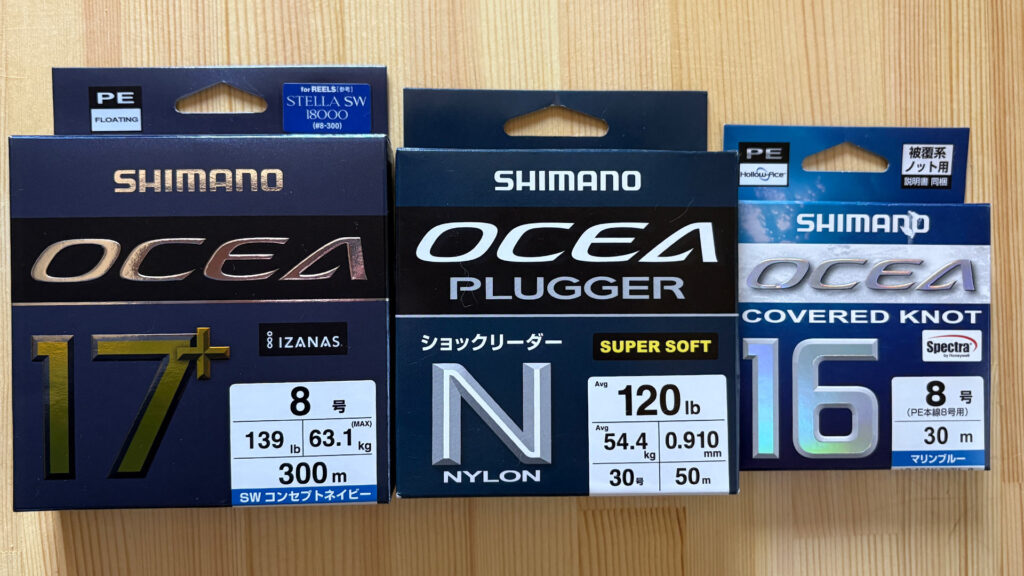
The numbers written on the packaging, like “Max Strength OO kg” or “OO lb,” represent the force measured when both ends of a completely straight line are secured and pulled slowly until it snaps. This is often called “straight strength” or “maximum breaking strain.”
The crucial point here is that the force applied to the line during actual fishing is not the “dead weight of the fish.” Fish live in the water. Because buoyancy acts upon them underwater, their raw weight never directly loads the line. The force applied to the line is actually the “force the fish exerts by swimming away.”
In other words, even if a 100kg tuna bites, 100kg of force is not constantly applied to your line. This is the first key point to understand.
2. Three Reasons Your Line Doesn’t Break
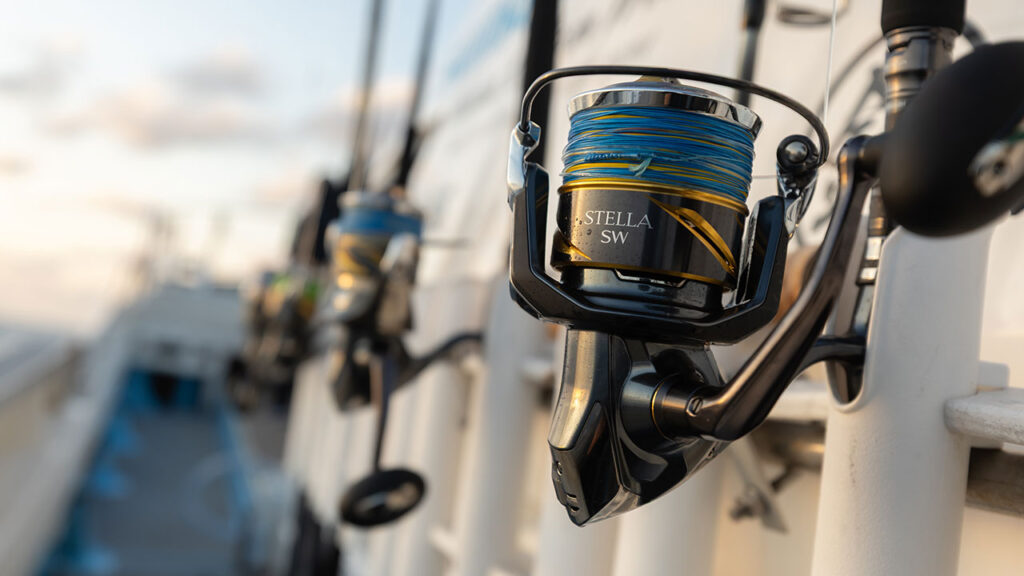
Reason 1: The Drag Protects the Line
The drag is a mechanism that lets the spool spin backward and release line when the force exceeds a set limit. By “releasing” the line the moment a fish pulls too hard, it actively prevents the line from snapping.
Generally, it’s recommended to set your drag to about 1/3 to 1/4 of your line’s maximum strength. For PE #1 (assuming a max strength of 9kg), the proper drag setting is 2.5 to 3kg.
If you calculate why 1/3 is the magic number, it looks like this:
- Manufacturing variations: 70%
- Strength loss at the knot: 70%
- Guide friction and line degradation: 60-70%
9kg × 0.7 × 0.7 × 0.6 = Approximately 2.6kg
This means about 1/3 of the line strength is your practical safety zone. As long as you fight the fish within this range, the line theoretically will not break.
You might think, “Is 2.5 to 3kg really enough?” Try hanging two large bottles of water (about 3kg or 6.6 lbs) and pulling the line with your hand. You’ll quickly realize it requires a massive amount of force.
Reason 2: The Rod Absorbs the Shock
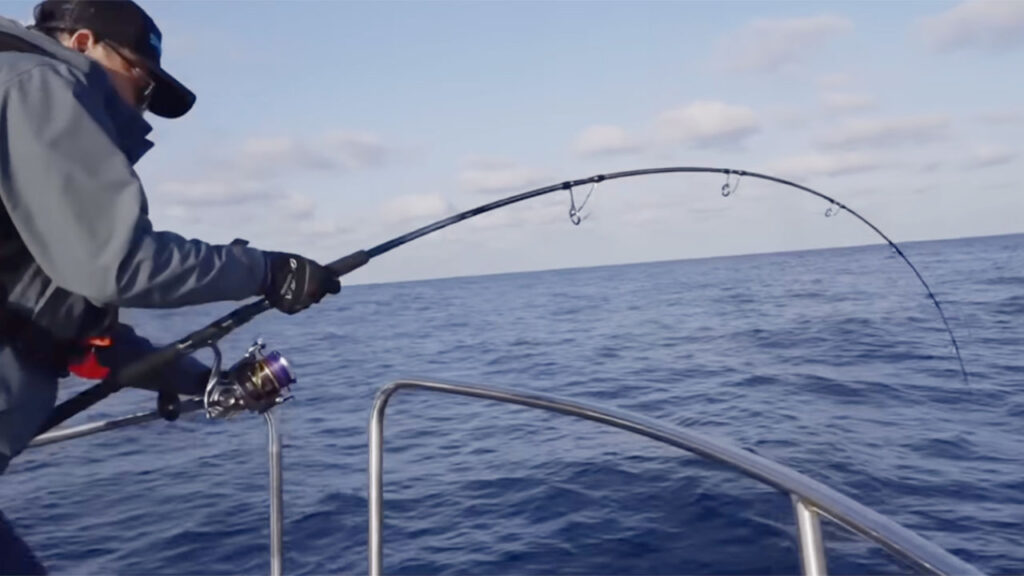
When a fish makes a sudden run, a massive force is momentarily applied to the line. The flex of the rod mitigates this “sudden shock.”
By bending, the rod disperses the force over time. It acts exactly like a spring. Even if 10kg of force is applied instantaneously, the rod’s flex slows down the transmission of that force to the line. It acts as a “cushion” before the drag even kicks in.
However, you must be careful here. If you hold the rod at too high an angle (high-sticking), the extreme friction between the line and the guides generates heat, which can burn the line and cause a break. This heat issue becomes a very real risk, especially when fighting fish on heavy drag settings.
Reason 3: Buoyancy and Water Resistance Are on Your Side
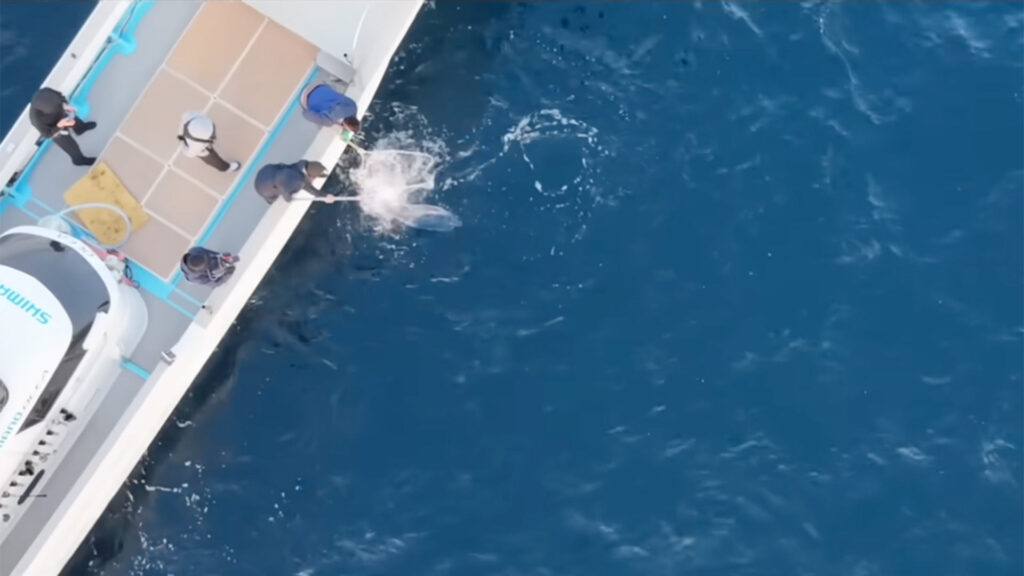
Buoyancy acts on the fish underwater. Even a 100kg tuna’s full weight is never fully transferred to the line as long as it remains submerged. The load on the line is merely the propulsive force generated by its swimming, not its raw body weight.
Conversely, the moment the line experiences the maximum load is when you lift the fish completely out of the water. Buoyancy drops to zero, and gravity hits the line directly. This is exactly why we use landing nets or gaffs. Once you understand the physics of line strength, this makes perfect sense.
3. The Force a Fish Applies is Not Its “Weight”
[Answer]
The force a fish exerts on your line is its “swimming propulsion,” not its body weight. Furthermore, a fish doesn’t swim at 100% power continuously; it runs, stops, and runs again. Through this ebb and flow, the drag and rod work together to protect the line.
This is the most widely misunderstood point. Just because a 100kg fish bites, it doesn’t mean 100kg of force is traveling down your line.
The force the fish imparts to the line is its swimming propulsion. Moreover, a fish doesn’t sprint at full speed forever. It runs, stops, and runs again. It’s a continuous cycle.
While the fish is running, your drag is releasing line. When the fish stops, you recover line. Throughout this exchange, the force acting on the line is constantly kept near your preset drag value.
Essentially, you are fighting the fish with the drag’s pressure. If your drag is set to 15kg, it means you are constantly applying a 15kg burden on the fish throughout the entire fight.
4. Then Why Do Lines Break?
[Answer]
Line breaks are rarely caused by exceeding the raw tensile strength. The main culprits are a combination of factors: friction heat from the guides, abrasion against rocks/obstacles, degradation at the knot, and the mechanical increase in drag tension as the spool empties.
If it shouldn’t break in theory, why does it break in reality? Let’s break down the actual causes of a line break.
Cause 1: Friction Heat from the Guides
When a fish makes a blistering run, the line passes through the guides at high speed, generating immense friction heat. PE line (Polyethylene) is incredibly vulnerable to heat. While it boasts incredible tensile strength, heat is its fatal weakness.
Its melting point is quite low, around 140-150°C, and its strength rapidly deteriorates even at temperatures below that. This is where high-end guide rings, like “SiC (Silicon Carbide)” or “Torzite,” come into play. They aren’t just “smooth.”
Their greatest weapon is their “overwhelmingly high thermal conductivity.” They instantly absorb the friction heat generated by the line and dissipate it into the surrounding metal frames and air. In short, premium guide rings act as highly efficient “cooling devices” to protect your line.
During a fight, your line comes up soaked in seawater. This seawater actually acts as “coolant.” Because it’s wet, the friction heat evaporates the water, preventing the line from melting.
You might have seen videos of big game fishing where smoke seems to pour out of the reel. That’s actually the seawater in the line boiling and turning into steam due to extreme friction heat.
Cause 2: Drag Increases as the Spool Empties
This is easily overlooked: as line is pulled out and the spool’s diameter shrinks, the actual force applied to the line increases, even if the drag knob hasn’t been touched. It’s the principle of leverage. The thinner the spool gets, the higher the effective drag value becomes.
Therefore, if a fish takes a massive amount of line and you leave the drag at its initial setting, the actual load on the line might exceed your safe limit. Properly, you need to slightly loosen the drag as more line goes out. You must constantly adjust—tightening and loosening—during a long fight.
Cause 3: Weakness at the Knots
As long as there is a knot, it will always be the weakest link. Depending on the tying method, the strength can drop to 50-80% of the line’s rating. Typically, you have connections between the PE line, shock leader, and split ring/swivel. In big game fishing, the PR knot is highly favored because it retains strength most consistently.
Cause 4: Abrasion and Obstacles
This is simply when the line rubs against sharp rocks, tetrapods, or a fish’s teeth. If this happens, it will snap regardless of whether it’s PE #1 or PE #12. As I mentioned in a previous article, if you rub against a reef, line thickness becomes largely irrelevant.
When targeting tuna, you must always anticipate a “second run” near the boat. A sudden dive under the hull can cause the line to rub against the boat and break. Usually, your guides face downward, but if the fish dives under, you must quickly rotate the rod so the guides face upward and lean the rod blank against the gunwale to protect the line from touching the boat.
Above all else, you must absolutely protect your line from abrasions.
5. Case Study: How PE #12 (89.5kg) Lands a 100kg Tuna
Let’s break down the mechanics of a 100kg tuna fight.
Assume we are using PE #12 and set the initial drag to 13-15kg. This is roughly 15-17% of the line’s 89.5kg breaking strain, which is an incredibly strong setting.
The tuna bites and takes off. The force on the line during this run is fundamentally capped at the 13-15kg drag setting. The tuna’s 100kg body weight is not directly loading the line. The drag yields and releases line, bleeding off the excess force.
The fish stops. You recover line. It runs again. The drag screams. The cycle continues.
Throughout the entire battle, the load on the line stays within the drag limits. Because only 13-15kg is being applied against an 89.5kg threshold, theoretically, it will not break.
The key here is that this 13-15kg force is continuously burdening the fish. Every time the fish swims, it’s dragging 15kg of resistance. Imagine a human trying to sprint while dragging a 15kg sled.
On the first run, it might sprint 100 meters without stopping. But the second run will be shorter. The third run shorter still. The fish drains its stamina with every surge because it’s constantly fighting that 15kg payload.
However, this implies fighting in deep water. In shallow waters, the fish can only run horizontally, increasing the risk of reef abrasion and completely changing the strategy. In deep water, the fish can dive, allowing you to steadily drain its stamina through continuous drag pressure.
This “process of exhausting the fish” is the true essence of the fight. You aren’t hoisting the fish up with the raw strength of the line; you are stripping its stamina with sustained drag pressure until it floats to the surface.
Once the fish surfaces, the battle is mostly won. There are still risks like guide heat and drag fluctuation from a depleted spool, which is where an angler’s skill is tested, but fundamentally, this is how the mechanics work.
6. How This Knowledge Upgrades Your Actual Fishing
Once you understand these mechanics, several things will change for you.
First, you gain the confidence to say, “Thin line is fine.” When targeting salmon or trout with PE #1, the anxiety of being broken off disappears. You know that if you set your drag correctly and utilize the rod’s flex, you are theoretically safe.
Next, your drag settings become grounded in logic. Instead of guessing “this feels about right,” you can accurately judge, “I’m setting this at 1/3 of my line strength, so I’m safe up to this point.”
If you set your drag to 3kg, you understand that any time the drag clicks, the fish is generating over 3kg of propulsive force. This helps you predict when you’ve hooked into a real monster.
Finally, your mid-fight decision-making improves drastically. When a fish makes a huge run, instead of blindly tightening the drag in panic, you remain calm: “My spool is getting thin, I should actually loosen it slightly,” or “If I hold the rod too high, the guide heat will be dangerous.”
When I started fishing for tuna, this was the most profound lesson I learned. Honestly, I didn’t think about it this deeply when I was just fishing for salmon and trout. But because of the knowledge I gained from tuna fishing, I can now fight confidently even on PE #1.
7. Conclusion: Line Strength is a “Safety Margin,” Not a “Limit”
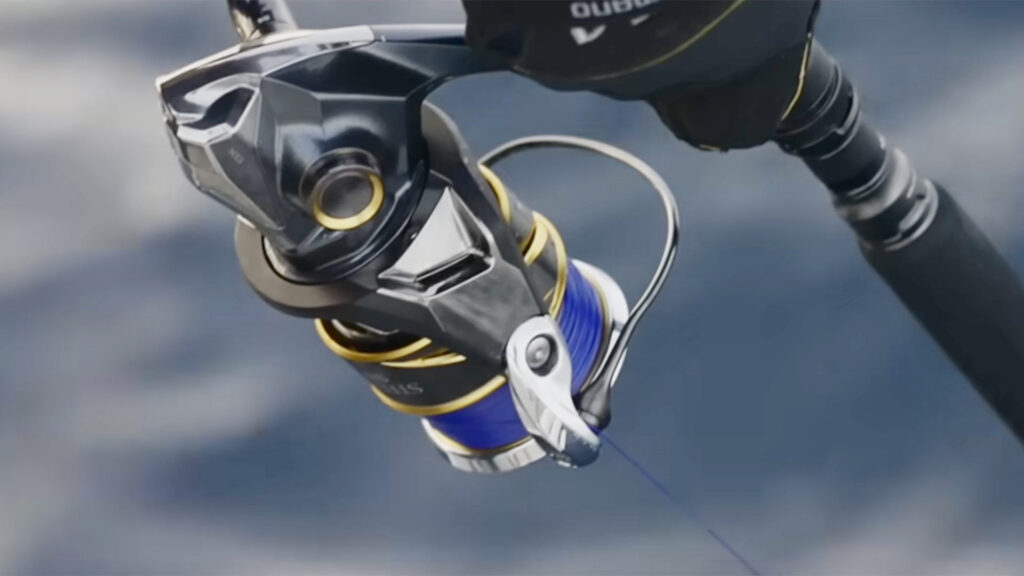
Let’s summarize. There are three reasons why we can land fish heavier than our line strength:
First, the drag controls the force applied to the line. When the fish runs, it gives line and bleeds off pressure. Thus, the actual tension is capped at the drag setting.
Second, the rod’s flex absorbs sudden impacts. By spreading momentary shocks over time, it softens the blow to the line.
Third, fish underwater have buoyancy. Their dead weight never rests entirely on the line. The only thing loading the line is their swimming propulsion.
Ultimately, line strength isn’t “the maximum weight of the fish you can catch”—it’s simply “the reference value for setting your drag.” Once you grasp this concept, your approach to tackle selection and fighting fish will completely change.
Fishing isn’t about “hoisting”; it’s the physics of “energy management.” We can land a 100kg tuna on an 89.5kg line because we continually burden it with 10-15kg of drag, slowly bleeding its energy away. The exact same logic applies when targeting Atka mackerel with PE #0.4.
If you distribute the load across your system and keep it below the line’s breaking limit, physics dictates you will land the fish. I believe this is the true thrill of angling.
It took me a while to fully comprehend this. But once I did, my entire perspective on fishing changed from the ground up. I hope this knowledge proves useful in your own fishing adventures as well.
-
QDrag settings are said to be 1/3 to 1/4 of the line strength, but specifically, how should I measure it?
-
A
Using a specialized tool like a drag checker is most accurate, but if you don’t own one, I recommend placing “water bottles” in a plastic bag, hooking a lure’s split ring onto it, and lifting. For example, by lifting 1.5 of 2L water bottles (about 3kg), and setting the drag so the line just starts to slip with a clicking sound, you can achieve accurate drag adjustment right in the field.
-
QHigh-end rod guides are said to have excellent \”heat dissipation,\” but can I not catch big fish with a cheap rod?
-
A
It’s not that you cannot catch them, but the risk of line break skyrockets. Cheap hard guides and the like have low thermal conductivity, so friction heat builds up in the line easily when a fish runs at high speed. For big game, or scenarios assuming fights with heavy drag, using a rod equipped with SiC rings or Torzite rings is the most reliable countermeasure against line breaks.
-
QUp to what weight is it okay to boat-flip (pull the fish out without using a net)?
-
A
As explained in the article, at the moment of pulling them out into the air, the \”fish’s pure body weight + shock from thrashing\” is applied directly to the line and rod. Because this relates directly to rod breakage (folding), not just PE line strength, I strongly recommend using a landing net or gaff for basically \”all fish exceeding 1kg.\”