“Big Game = Topwater Game.” We are often misled by this simple equation. Think about it: tackle manufacturers never explicitly say, “Fishing for Yellowtail Kingfish (Hiramasa) and Bluefin Tuna is exactly the same.” It’s us, the anglers, who have mistakenly made that assumption.
Bluefin Tuna casting. You stare at the ocean surface from a rocking boat for hours, and your chances might come down to just a few full casts a day. It is a harsh reality of this fishery that paying a high charter fee and returning to port without swinging your rod even once is completely normal.
My home ground is the waters off Shakotan, Hokkaido. There have been many times when I set out fully pumped to fish, only to end up on what felt like a mere “Shakotan sightseeing cruise.” It’s not a laughing matter, though.
Whether it’s good karma or just luck, if you happen to be out on a day when Bluefin Tuna are jumping right after departure, a massive opportunity suddenly presents itself.
Any angler targeting tuna knows this, but once a feeding frenzy (boil/schooling) erupts, the atmosphere on the boat instantly becomes electric and aggressively competitive! It’s genuinely intimidating (laughs).
However, veteran anglers who actually land tuna act differently. They assess the situation more calmly than anyone else. Standing slightly apart from the frenzied crowd, they watch with a predatory gaze, calculating the absolute best timing.
When they judge the moment to be optimal, they cast without hesitation and secure a hookup. But even for these veterans, the real battle begins the moment the fish is on. At that point, they aren’t worrying about line breaks or pulled hooks.
Why? Because their preparation is already perfect. The only unpredictable factor is the size of the fish, which is completely out of their control. They gauge the weight during the first run and transition into the fight. While no one can predict exactly what will happen during the battle, their mental readiness is set. They rely on their accumulated experience and prior simulations.
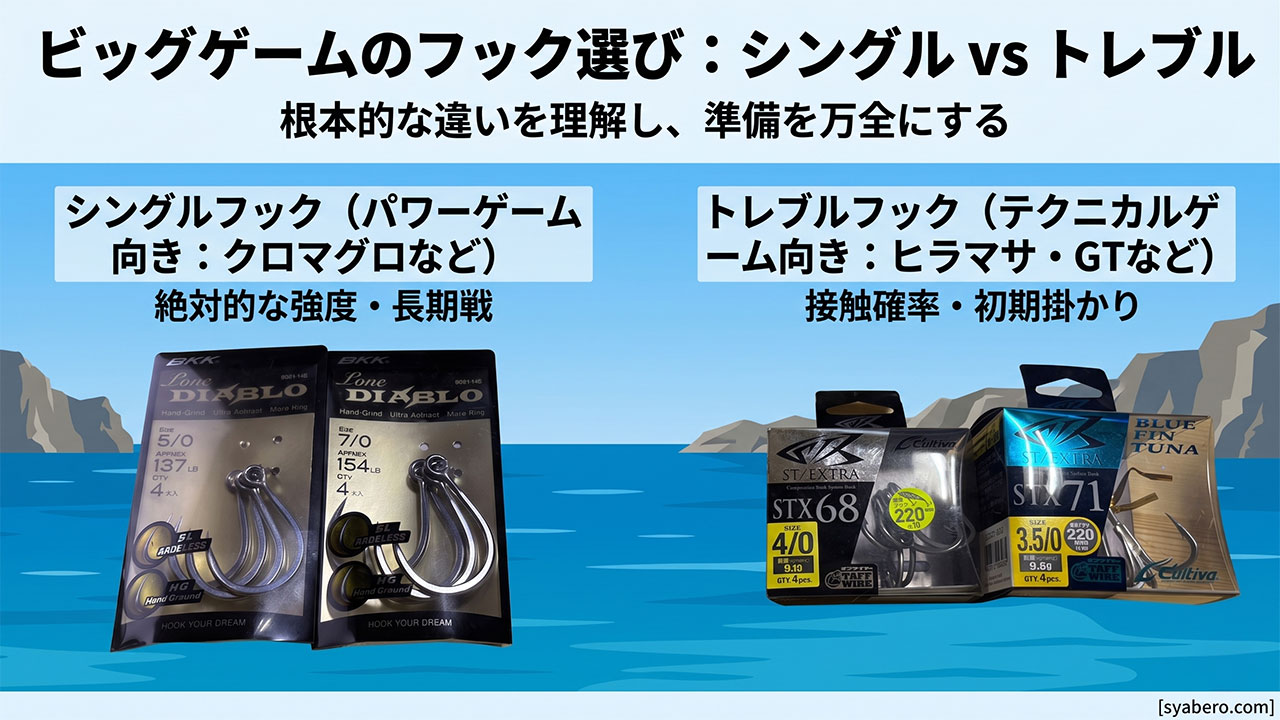
In casting games, “hook selection” is an eternal dilemma for us anglers. Single or Treble?
- Understanding the Fundamental Differences to Ensure “Perfect Preparation”
- The Boundary Between Technical and Power. Field-Proven Characteristics.
- Even Rod Selection Changes. The Dilemma of the Ocea Plugger Limited 88H
- A Shocking Reality. The Despair of a 35kg Tuna that Felt Like 70kg
- Why Single Hooks Are the Standard for Bluefin Tuna
- Conclusion: Make Hook Choices That Allow You to Claim “Preparation is Perfect”
Understanding the Fundamental Differences to Ensure “Perfect Preparation”
To achieve that state of “perfect preparation” mentioned earlier, you first need to accurately understand the true nature of the fishery you are facing.
Manufacturers and YouTube videos often lump Yellowtail Kingfish/GT (Giant Trevally) and Bluefin Tuna together under the umbrella of “Big Game” or “Large Topwater Game.” However, if you actually keep casting lures in the field, you realize that the characteristics of these fisheries and the required skills are completely different.
Without understanding this fundamental difference, you cannot make the right hook choice.
Speaking honestly from the perspective of having experienced both fisheries, let’s compare these two species.
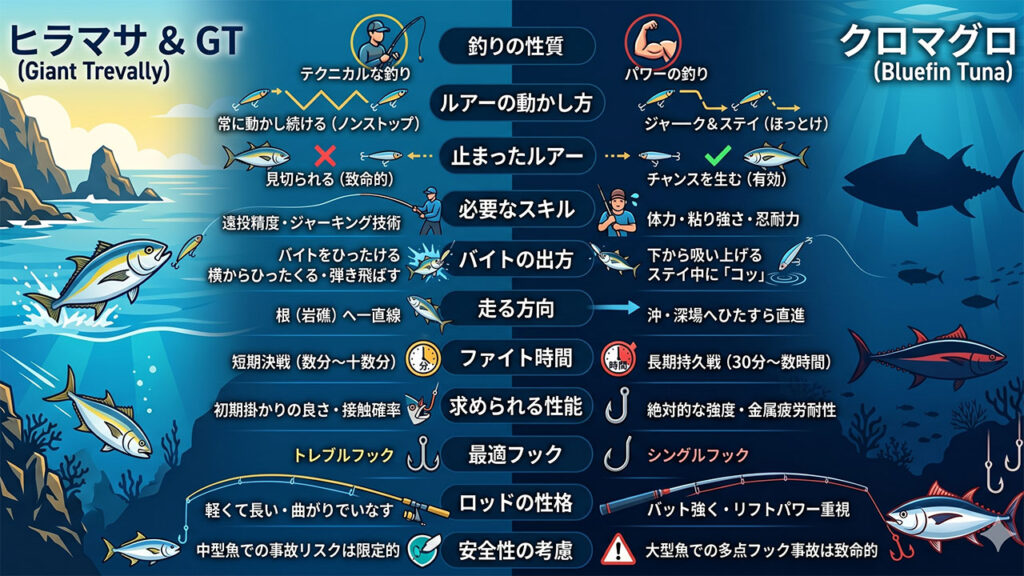
Comparison Table: Technical Game vs Power Game
| Category | Yellowtail Kingfish / GT | Bluefin Tuna |
|---|---|---|
| Nature of Fishery | Technical Game | Power Game |
| Lure Action | Continuous movement (Non-stop) | Jerk & Stay (Dead sticking) |
| Stopped Lure | Ignored by fish (Fatal mistake) | Creates an opportunity (Effective) |
| Required Skills | Casting accuracy & Jerking technique | Physical stamina, persistence, patience |
| Bite Pattern | Snatches from the side, blows up lure | Strikes from below, often during a stay |
| Running Direction | Straight toward reefs/structure | Straight out to open water/depths |
| Fight Duration | Short sprint (minutes to ~10 mins) | Endurance battle (30 mins to hours) |
| Required Hook Spec | Initial hookup rate, contact probability | Absolute strength, metal fatigue resistance |
| Optimal Hook | Treble Hook | Single Hook |
| Rod Character | Light, long, bends to absorb shocks | Strong butt section, emphasis on lifting power |
| Safety Concerns | Accident risk is limited with medium fish | Multi-hook accidents with huge fish are fatal |
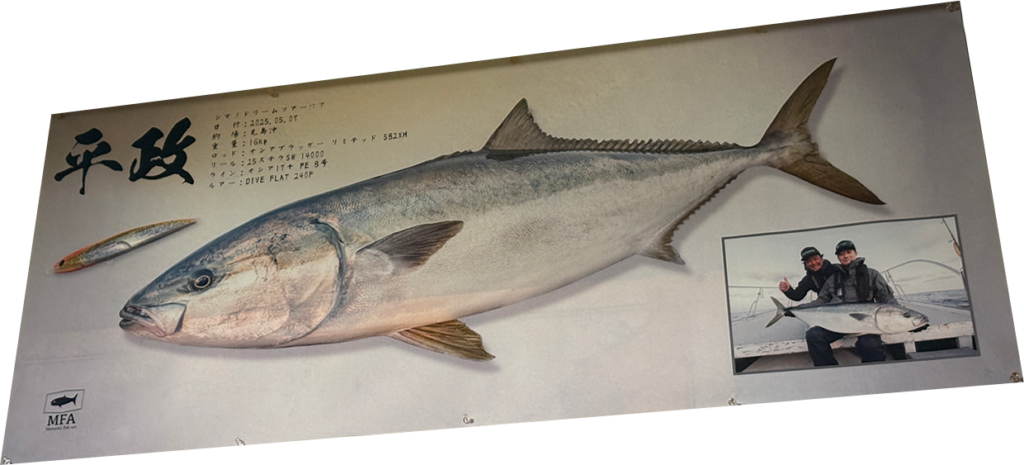
Yellowtail Kingfish & GT: A “Technical Game” Where Stopping Means Losing
When targeting Kingfish or GT, I believe that “the time the lure is stopped is a losing battle.” Once you cast, you must keep the lure moving. If you pause too long, the fish will figure it out and turn away. Because it’s a fishery that triggers “reflex” bites through speed changes and lure slides, long-distance casting accuracy and jerking technique are incredibly important.
That is exactly why the “hookup rate” of a treble hook, which reliably catches aggressive, side-swiping bites, is a massive advantage. Trebles, which increase the chance of contact and can secure a multi-point hookup even on a shallow inhalation, are an essential choice for this game.
Furthermore, Kingfish and GT fishing often occurs around reefs and shallows, and immediately after hookup, they dive headlong for the rocks. It’s a short-term battle where you must set the hook quickly and pull the fish away from the structure. It’s no exaggeration to say this dictates the entire game.
Bluefin Tuna: A “Power Game” That Rewards Dead Sticking
On the other hand, Bluefin Tuna exist in a different world. Looking back at the patterns where I’ve hooked tuna, the overwhelming majority of strikes concentrate on a “Jerk & Stay” combination.
- Several jerks immediately after splashdown
- Followed by a long stay (dead sticking)
- Two more jerks → Another bite during the stay
It is said that Bluefin Tuna can rise from depths of 50 meters to the surface in just a few seconds. They closely inspect a lure that has been resting for over 10 seconds, and finally thrust upward to engulf it. Unlike Kingfish, there isn’t a feeling that “you won’t catch anything if you aren’t constantly moving it.” Instead, it feels like a fishery where you let them see it clearly, let them think, and finally make them decide to bite.
Interestingly, for anglers who aren’t confident in their casting or jerking, Tuna might actually be more suitable than Kingfish. As long as the lure reaches the target area, there are plenty of scenarios where you get a bite simply by leaving it alone. Of course, the fight requires immense stamina, but the hurdle for casting and jerking isn’t as high as it is for Kingfish. That’s the honest truth.
The Boundary Between Technical and Power. Field-Proven Characteristics.
The “Motion” of the Kingfish and the “Stillness” of the Tuna. Once you understand this decisive difference, it changes not only your hook selection but your entire approach on the water. I’ve organized these real-world sensations into a chart.
[Yellowtail Kingfish/GT: Technical Game]
– Continuous movement (Ignored if stopped)
– Casting distance and jerking technique are essential
– Multi-point hookups with treble hooks
[Bluefin Tuna: Power Game]
– Stay after jerk, dead sticking is effective
– Physical stamina and tenacity are the deciding factors
– Suited for long battles with single hooks
| Category | Best for Kingfish/GT | Best for Bluefin Tuna |
|---|---|---|
| Rod Length | Longer (Prioritizes casting distance) | Can be slightly shorter (Prioritizes power) |
| Rod Character | Light, easy to swing, absorbs shock | Strong butt section, emphasis on lifting power |
| Line | Thinner for casting distance & sensitivity | Thicker for sheer strength & reliability |
| Required Skills | Casting accuracy & Jerking tech | Physical stamina & Tenacity |
Kingfish won’t bite unless the angler keeps the lure alive and dynamic. But a Bluefin Tuna, if you accurately place the lure ahead of a feeding frenzy and just let it drift in the waves, has a high probability of “catching itself.” That is why the process up to the hookup is far more difficult with Kingfish, but the sheer despair after the hookup is infinitely worse with Tuna.
Even Rod Selection Changes. The Dilemma of the Ocea Plugger Limited 88H
This characteristic difference between “Technical” and “Power” is most evident in rod selection. Take, for example, Shimano’s masterpiece, the Ocea Plugger Limited 88H. It’s long, bends beautifully, and can cast even lightweight lures an unbelievable distance. For Kingfish, it is an undeniable masterpiece. However, if you bring this rod to a Tuna fight, its advantages vanish instantly.
In tuna casting, overwhelming casting distance isn’t always strictly required. In an extreme example, even a physically smaller female angler or someone who can’t work a lure perfectly can secure a hookup just by dropping the lure in the tuna’s path and leaving it (“dead sticking”).
The problem is after the hookup. During the fierce power and long-duration fight unique to tuna, a long, supple rod like the 88H places intense strain on the angler’s lower back and arms. Anyone can hook them. But whether you can land them depends on your raw physical power, your build, and the rod’s lifting capability. This is the cruel reality of the Big Game.
I personally currently use the MONSTER DRIVE S83XH-3.
If you are looking to start, I recommend the Ocea Plugger Limited 82XH as a manageable choice for targeting the ~70kg class typical around Shakotan. For areas like the Tsugaru Strait where massive fish are expected, the newly released BLUEFIN TUNA S73XXH would be a good option.
A Shocking Reality. The Despair of a 35kg Tuna that Felt Like 70kg
I confidently state that Tuna is a power game. However, I had one experience in the past where my stamina and experience completely glitched out.
On a trip a few years ago, I hooked a tuna that carried a weight I had never felt before. The drag screamed, and an unprecedented load transferred to the rod. I braced myself, thinking, “This is definitely over 70kg.”
However, as the fight dragged on, I exhausted myself first. Thinking, “This is really bad,” I had my friend on the boat, Michishio Papa, take over the rod.
Working together, drenched in sweat, we finally dragged a massive shadow to the surface. But when we weighed the tuna in the net, we were left speechless. It wasn’t over 70kg; it was a mere 35kg.
We were even more shocked when we looked at the fish. Actual weight: 35kg.
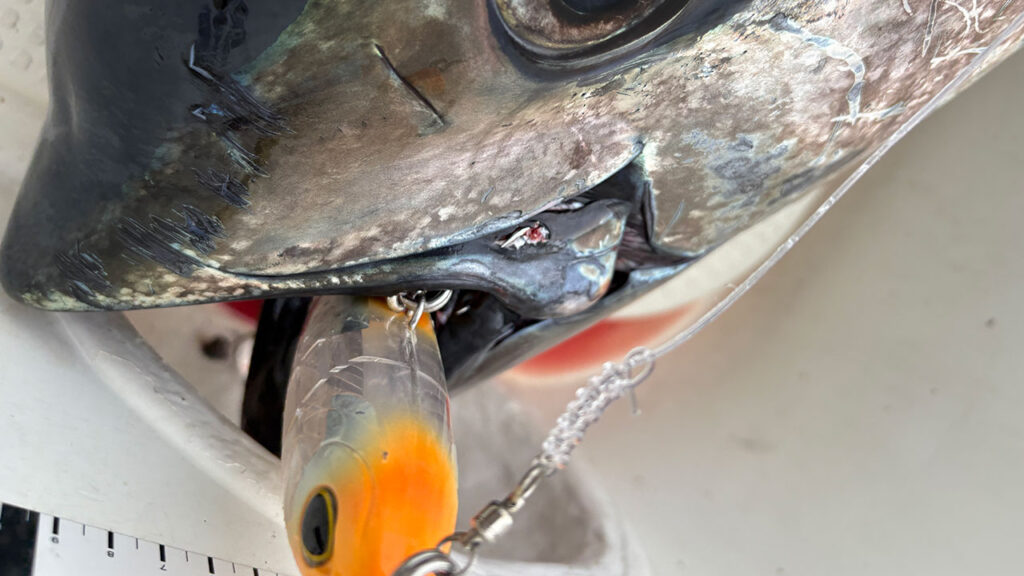
Physically, it felt as heavy as the 50kg class, perhaps even more, yet numerically, it was a “small” size. Observing the fish closely revealed the cause immediately. Two single hooks were deeply embedded in a very awkward position, and the fish’s orientation remained terrible, meaning its entire dead weight had been directly loading the rod and line the whole time.
What I strongly realized then was: Even if it’s the exact same 35kg, depending on where and how many hooks engage, the perceived weight is completely different. The hook placement can dictate the entire fight—this is a fact.
When hooks grab awkwardly in multiple spots, the tuna cannot open its mouth to breathe. Then, the pulling angle becomes distorted, and the fish is forced to come up completely “sideways.”
The water resistance in the ocean combined with the weight of a tuna forced sideways generates a despairing load that tricks you into thinking it’s double the size. Just using a single hook doesn’t automatically make the fight easier. A single misplaced hook can easily overturn the laws of physics underwater—I learned this the hard way.
Why Single Hooks Are the Standard for Bluefin Tuna
The Equation: Unmatched Jaw Strength × Long Fights × Metal Fatigue
A Bluefin Tuna fight can last for hours. If you use treble hooks in this environment, the three points receive force from different directions, increasing the risk of opening or breaking due to leverage. Metal fatigue also accumulates easily.
On the other hand, with a single hook, the force concentrates on one point. A heavy-wire single hook has high resistance to bending and breaking, making it a structure suited for endurance battles. If it firmly penetrates the corner of the mouth (the hinge), it will rarely come off. This absolute peace of mind is the primary reason tuna anglers choose singles.
The Reality of Safety and Regulations
When a 100kg class fish thrashes at the side of the boat, an accident where a massive treble hook impales a human is fatal. Furthermore, from a resource management perspective in recent years, regulations requiring catch-and-release, barbless hooks, or single-hook-only setups are increasing. These practical constraints are also a significant reason why singles are mainstream for Bluefin Tuna.
Conclusion: Make Hook Choices That Allow You to Claim “Preparation is Perfect”
Superficial knowledge or stubbornness like “Singles are easier to land” or “Trebles don’t pull as easily” is useless on the ocean.
Yellowtail Kingfish/GT and Bluefin Tuna. While often categorized together under “Big Game,” actually casting lures and facing the fish reveals they are entirely different in the nature of the fishery, lure action, bite patterns, required tackle, and physical demands.
Therefore, hook selection cannot be generalized.
- Yellowtail Kingfish / GT → Treble hooks are logical
- Bluefin Tuna → Single hooks are logical
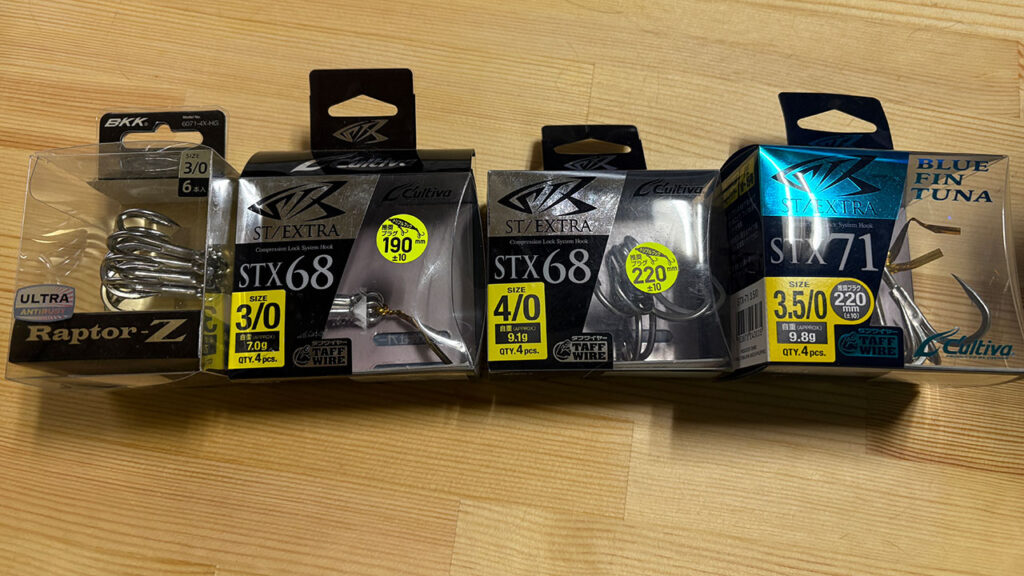
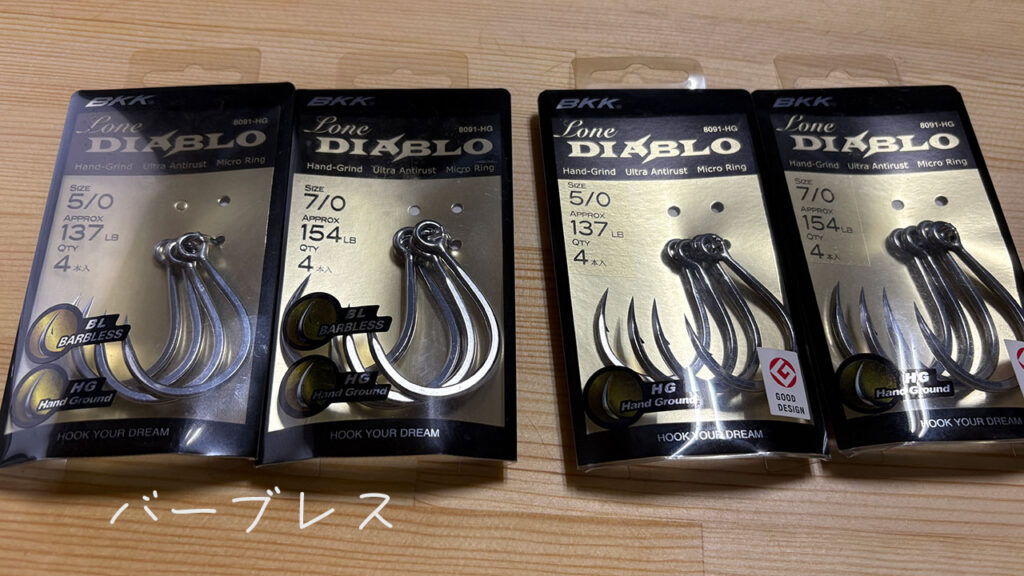
Ultimately, you should make your decision by comprehensively considering the lure’s design intent, the ocean conditions of the day, and your own physical strength and skill.
The important thing is being able to declare that your preparation is perfect, as mentioned at the beginning. Why did you choose that hook? What kind of fight will it be when that hook sets? Whether or not you’ve simulated that beforehand is what separates those who can calmly fire a cast into a chaotic feeding frenzy from those who cannot.
Trebles to keep the lure dynamic in technical fisheries like Kingfish. Singles to endure long battles in power games like Tuna. And the reality that even that common sense can be easily overturned in the field by just one awkward hook placement.
In fishing, an absolute insistence that “it must be this way” sometimes strangles the angler. Understand the fish’s ecology, and based on that, decide how you will fight the monster in front of you. That flexible thinking is exactly what will elevate you to a true Big Game angler.
Q
What are the differences between topwater fishing for Yellowtail Kingfish (GT) and Bluefin Tuna in Japanese waters?
A
There is a clear distinction: Kingfish represents “Motion,” while Bluefin Tuna represents “Stillness.” Kingfish and GT fishing in Japan is a “technical game” where you must constantly keep the lure moving. Stopping the lure often results in the fish turning away, which demands high casting accuracy and jerking techniques. On the other hand, Bluefin Tuna casting in areas like Shakotan is a “power game” where long stays or “dead sticking” after jerking are highly effective. For tuna, physical stamina and tenacity during the fight are often more crucial than pure casting technique.
Q
Why are single hooks mainstream for Bluefin Tuna casting games, rather than the treble hooks used for Kingfish?
A
Because single hooks offer superior durability during fights characterized by massive, prolonged loads unique to Bluefin Tuna. Treble hooks pose a higher risk of bending or breaking due to leverage, and they rapidly accumulate metal fatigue. Conversely, heavy-wire single hooks concentrate the force on a single point, and once they secure the corner of the mouth (hinge), they rarely pull out. Furthermore, single hooks are standard because they prevent fatal accidents when 100kg-class fish thrash at the boat side, and they comply with catch-and-release regulations.
Q
Are there disadvantages to using a long, highly flexible distance-casting rod, such as Shimano’s Ocea Plugger Limited 88H, for Bluefin Tuna?
A
Yes, the primary disadvantage is that it places an intense physical burden on the angler’s lower back and arms. While a long, flexible rod is a major asset for targeting Kingfish, in the grueling, prolonged power struggle characteristic of Bluefin Tuna, the length of the rod leverages against the angler. Since tuna casting prioritizes butt strength and lifting power to raise the fish after hookup over extreme casting distance, a slightly shorter, more powerful rod (e.g., Ocea Plugger Limited 82XH) is generally more suitable.