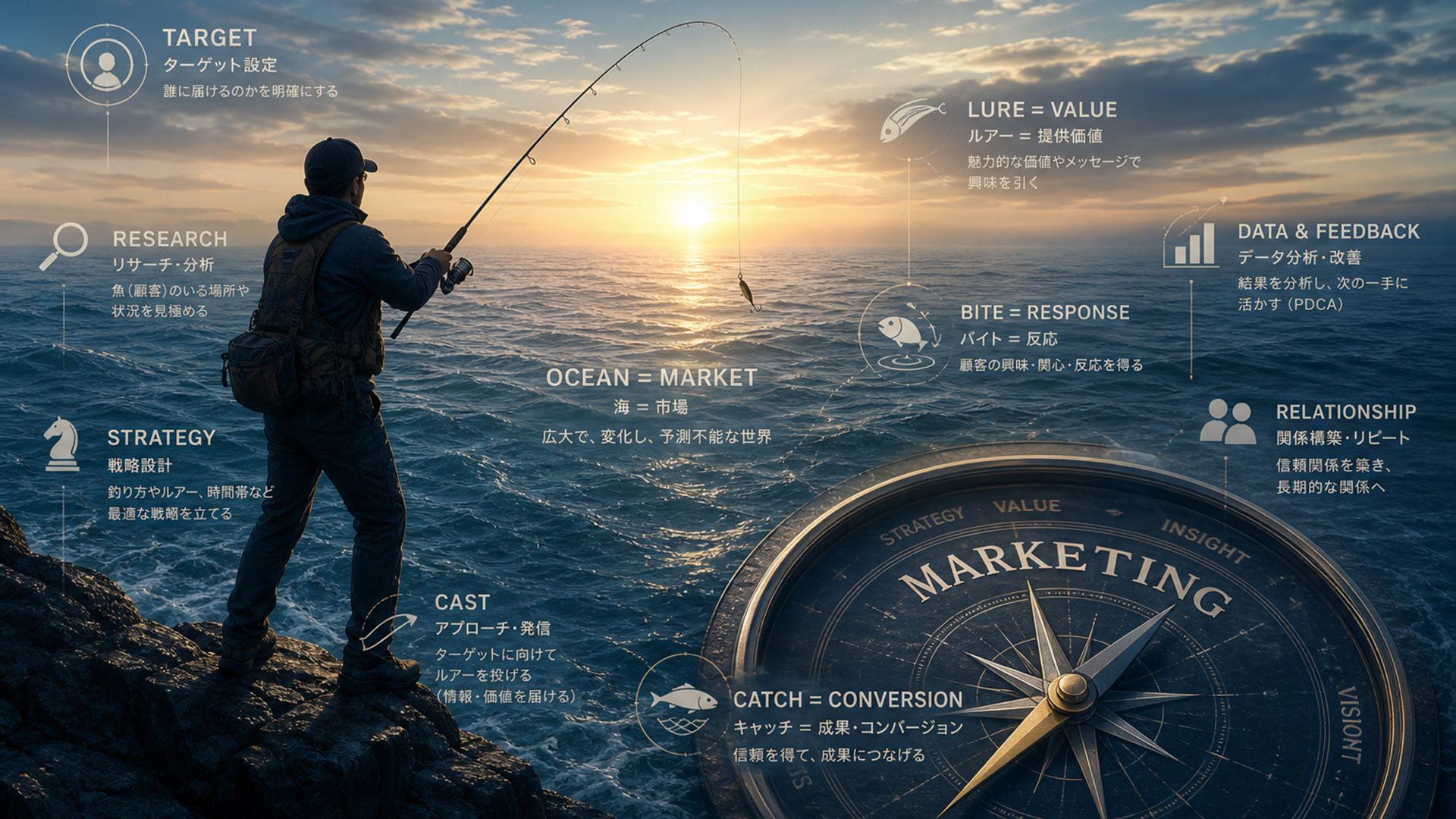
- Why Are Fishing and Marketing So Similar?
- What is “Match the Bait”? ── The Essence of Customer Understanding Taught by Fishing
- “Match the Bait” in Marketing ── 3 Elements to Identify What Customers Want “Right Now”
- “Fish Where the Fish Are” ── Market Selection is the Ultimate Prerequisite
- What is “Big Bait, Big Fish”? ── The Strategy for Targeting Trophies
- The “Big Bait” Strategy in Marketing ── Why You Need a Premium “Top-Tier” Option
- Trial and Error and PDCA ── Continuously Increasing “Resolution” in Both Fishing and Marketing
- “Match the Bait” or “Big Bait”: Which Should You Choose? ── The Business Decision Between Stability and Challenge
- Marketing Mindset Learned from Fishing ── 3 Practical Lessons
Why Are Fishing and Marketing So Similar?
Atomic Answer
Fishing and marketing are fundamentally the same in that both require identifying “what the target wants” and approaching them with the right method at the right time. The thought process of an angler analyzing fish behavior and environments aligns perfectly with a marketer’s job of analyzing customer needs and market conditions.
In the fishing world, there is a phrase called “match the bait.” It means matching your lure to the baitfish the target fish is currently eating. It’s not some grandiose quote, but an absolute basic principle known to every angler. However, surprisingly few people realize that this obvious concept applies perfectly to the world of marketing as well.
Both fishing and marketing share the exact same essential structure. You must figure out what the target (the fish or the customer) is looking for and approach them at the right time in the right way. If you can’t do this, no matter how excellent your equipment (product) is, you won’t see results.
Veteran anglers can feel and judge this instinctively. What is the bait in this area at this time of year? What is the water temperature? How is the tide flowing? They sense these factors based on experience, select their lure, decide where to cast, and sometimes even change their retrieve speed. Veterans make these decisions in an instant.
For those with less experience, it’s necessary to gather and accumulate as much of this information as possible.
The same goes for marketing. Veteran marketers achieve results by constantly analyzing what problems customers are facing right now, what price range they are looking for, and what timing is optimal.
Anyone who knows fishing should intuitively understand the essence of marketing. Conversely, when someone who has studied marketing starts fishing, they are often surprised to find, “Wait, this is just like my job.”
What is “Match the Bait”? ── The Essence of Customer Understanding Taught by Fishing
Atomic Answer
“Match the bait” is a fundamental fishing principle where you choose a lure that matches the size, shape, and color of the prey the target fish is eating right now. If a tuna is feeding on 12cm sardines, you use a 12cm lure; if it’s eating 20cm squid, you use a 20cm lure. A difference of just a few centimeters can drastically change your catch rate.
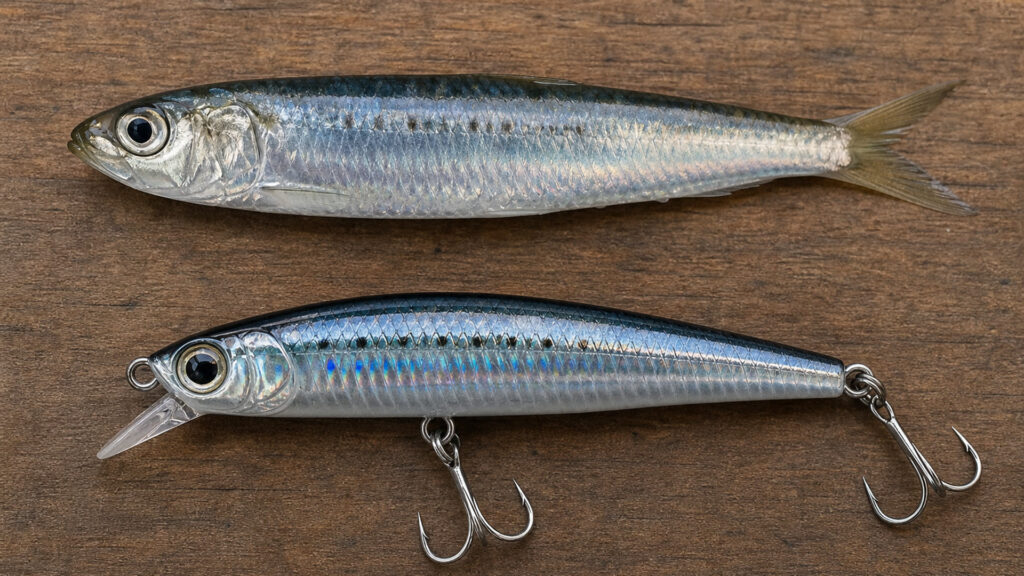
For example, think about targeting tuna. If the tuna in that area are feeding on 12-13cm sardines, you match your lure to that size. If they are eating small 20cm squid, you match the size and silhouette to that. This is “match the bait.”
No matter how proven or expensive the lure is, if the size isn’t right, the fish won’t even look at it.
I think this applies to humans as well. Imagine you are in the mood for Korean BBQ and have your heart set on it, but someone invites you to go eat high-end sushi.
Because you’ve already decided on BBQ in your mind, you probably won’t feel like eating the sushi, even if it’s placed right in front of you. On the other hand, if BBQ is presented to you, you’d likely jump right at it.
If you throw a 30cm lure and get no reaction, it’s not because of your skill or your tackle. It’s simply because it’s not what the fish wants to put in its mouth right now. That’s the only reason.
To a non-angler, it might seem hard to believe that a few centimeters could make a difference. But it does. It changes drastically. A fish that wouldn’t bite a 13cm lure will suddenly strike when you switch to 15cm. Conversely, dropping from a 20cm lure with zero reactions to a 12cm one can result in back-to-back catches.
Fish clearly choose what they want to eat at any given moment. Their selections are incredibly strict, and “close enough” often just doesn’t cut it.
“Match the Bait” in Marketing ── 3 Elements to Identify What Customers Want “Right Now”
Atomic Answer
To put “match the bait” into practice in marketing, you must accurately grasp three elements: (1) what product the customer is looking for, (2) what price range and volume they desire, and (3) why it has to be “now.” Miss these three, and no matter how great the product is, it won’t be picked up.
The structure is exactly the same in marketing. What do your customers want right now? What price range are they looking for? And why does it have to be “now”? If you miss these three points, even the most excellent product will go ignored.
- Element 1: Accurately grasping “what” the customer wants. Sellers tend to put out what they want to make, or what they think is good. However, there is often a gap between what the customer wants and what the seller wants to deliver. In fishing, this is like continuing to cast your favorite lure while ignoring the fish’s preferences. No matter how beautiful that lure is, or how well it has worked in the past, it’s meaningless if it’s not what the fish in front of you wants to eat right now.
- Element 2: Matching the price range and volume. This corresponds to the size of the lure. A product that deviates drastically from a customer’s budget or desired level may not even be recognized as an option. For example, recommending a high-end reel to a beginner won’t resonate, and showing a cheap starter kit to a veteran angler won’t spark interest. It’s necessary to match the scale of what the customer feels they need right now.
- Element 3: Don’t miss the timing. This corresponds to the changes in seasons or bait patterns in fishing. Even for the same species of fish, what they eat in spring is different from autumn. Morning is different from evening. It’s the same in marketing: the response will be completely different depending on whether you release rainwear right before the rainy season or in the middle of summer. Customers have a “reason to buy it now,” and if you miss that timing, they will pass over even the best products.
If you thoroughly execute “match the bait,” your catch rate will stabilize. In business too, if you release a product perfectly aligned with customer demand at the right timing, you will definitely see results. It is solid, highly reproducible, and hard to fail. This is an undeniable fact and the correct answer in many situations.
“Fish Where the Fish Are” ── Market Selection is the Ultimate Prerequisite
Atomic Answer
No matter how excellent your lure is, you can’t catch fish where there are none. Marketing is the same: no matter how good your product is, it won’t sell in a market without customers. Whether it’s industry expos and LinkedIn for BtoB, or SNS and review sites for BtoC, identifying where your target customers are already gathering is the highest priority.
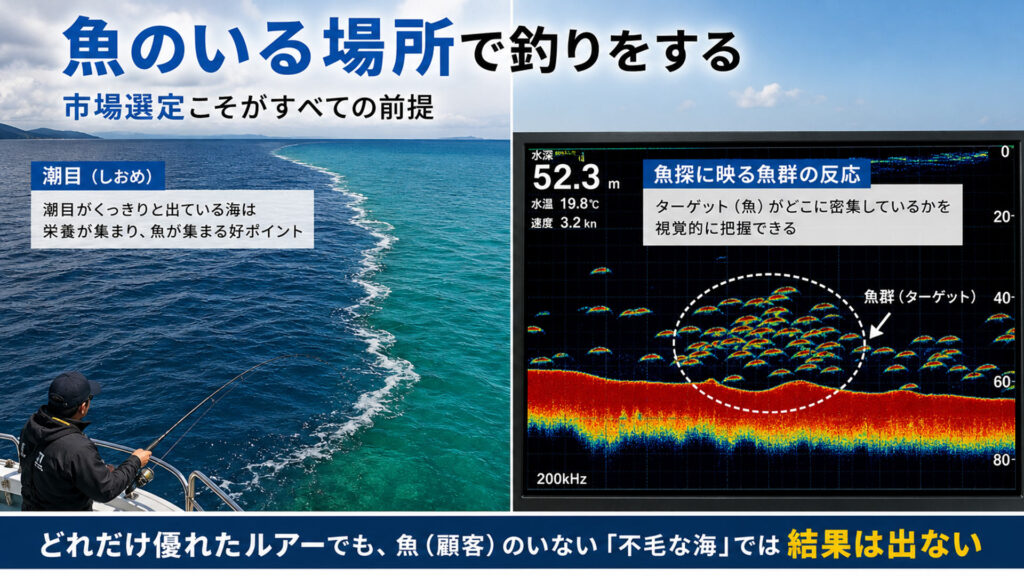
However, before even thinking about “match the bait,” there is a more fundamental prerequisite. That is to “fish where the fish are.”
No matter how great your lure is, and no matter how much you study the fish’s preferences, you can’t catch anything in a place where there are no fish to begin with. It seems too obvious and is easily overlooked, but this is the most important thing.
Anglers use SNS and other tools to search for spots where the fish are. There are definitely lurkers and stealth followers out there. Once you know where the fish are, 80% of your catch is virtually guaranteed.
However, relying solely on this won’t last long. The spots you find on your own two feet and the experiences you gain are irreplaceable.
Marketing is the same. No matter how good the product is, it won’t sell in a market with no customers. Pinpointing the places where your customers are already gathering is the top priority.
- For BtoB business: Industry trade shows, specialized LinkedIn groups, industry media, and Chamber of Commerce networking events are “where the fish are.”
- For BtoC business: Instagram, TikTok, Google searches, review sites, and specific communities are places where target customers are already spending their time.
A small company can’t win by competing in the exact same spots as major corporations. It’s crucial to find niche fishing spots that big companies ignore—spots that only you know about. There, even a small company can achieve solid results.
Think thoroughly about “Where are my friends (customers)?” and show up in those places using the right methods. If you can’t do this, no fantastic product or precise “match the bait” strategy will work.
What is “Big Bait, Big Fish”? ── The Strategy for Targeting Trophies
Atomic Answer
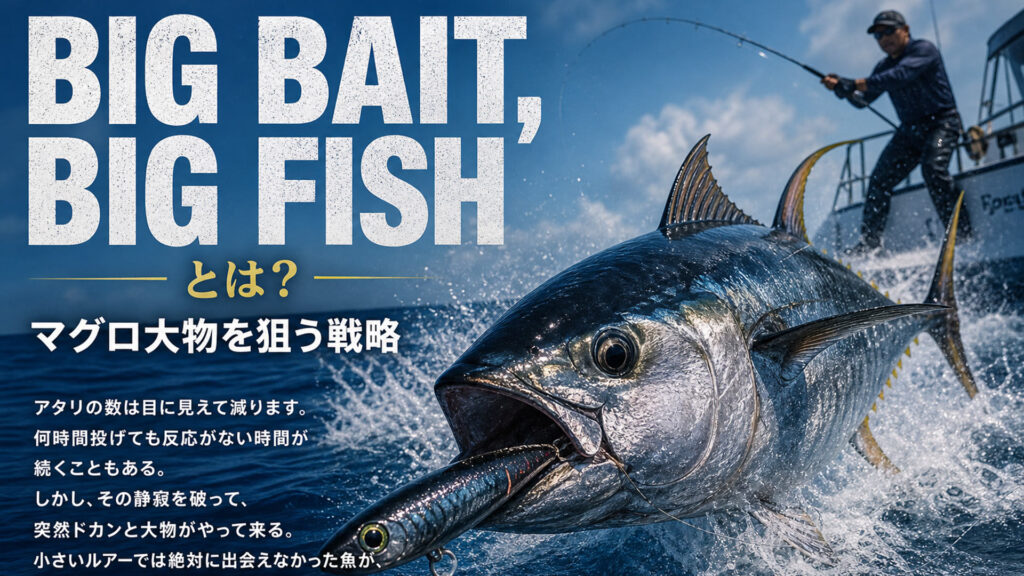
“Big bait, big fish” is a fishing proverb meaning that big baits attract big fish. Small lures might catch numbers, but they won’t catch trophies. Using large lures drastically reduces the number of bites, but only the massive fish that you’d never encounter with small lures will react. Big fish instinctively consume large prey to take in energy efficiently.
If you master “match the bait,” your results will be stable. However, there is another school of thought in fishing.
“Big bait, big fish.” The philosophy that a large bait brings in a large fish.
If you match small bait, you can catch numbers. You rarely miss. You can expect consistent results. But you won’t land the real monsters doing that alone.
When you throw a large lure, smaller fish determine it’s not their prey and won’t bite. They might come look at it, but they won’t strike. Fish generally school with others of the same size—schools of small fish, and schools of large fish. However, in areas where bait is concentrated, they can be mixed, and it’s often predicted that schools of larger fish are lingering beneath the smaller ones.
The number of bites will visibly drop. You might cast for hours with zero response. But breaking that silence, a monster will suddenly slam it. A fish you would absolutely never cross paths with using a small lure will strike precisely because it’s a big lure. That world exists.
Why do big fish react to large bait? The reason is simple: for a massive fish, small prey is inefficient. To get the calories needed to sustain their large bodies, they would have to eat dozens of tiny fish. It makes much more sense to eat a large bait that provides a massive dose of energy in a single bite.
That’s why big fish choose big bait. It is a rational choice based on instinct.
The “Big Bait” Strategy in Marketing ── Why You Need a Premium “Top-Tier” Option
Atomic Answer
In business, a “big bait” means properly preparing a premium “top-tier” option (the highest of a good/better/best pricing model). If you only line up affordable options, you won’t land major customers. People who want the premium option will buy it at a premium price, and its very existence elevates the perception of your entire lineup. The crowd that buys the mid-tier and the crowd that buys the top-tier are fundamentally different fish.
Translating this to marketing, it means properly setting up the “top-tier” (the highest level in a tiered pricing structure).
Many people feel safe offering only mid-tier or budget options. Affordable price points make it easier for people to buy. The risk is low. Volume goes up. That is a correct judgment and necessary as a business foundation. But without a top-tier option, you cannot land big clients.
What is often overlooked is the fact that people who want the premium tier will buy it regardless of the high price. The demographic that buys the mid-tier and the one that buys the top-tier are entirely different fish. If you only offer mid-tier options, you won’t even enter the field of vision of those seeking the best. They are looking for something that matches their status, not something that is just “affordable.”
Furthermore, the very existence of a premium tier changes the impression of your entire lineup. Having a top-tier makes the value of the mid and lower tiers stand out. It’s a psychological quirk: when there is an expensive option at the top, the middle product suddenly looks like the “perfectly reasonable choice.” Conversely, a lineup lacking a premium option feels like it has a low ceiling. It subconsciously gives the impression of, “Is this the best they can do?”
Casting a big bait requires resolve. It’s true in fishing. While everyone around you is happily catching fish with small lures, you are the only one continually casting a huge bait. Long stretches of time pass with zero reaction. You might even feel self-conscious about others watching you. You can almost hear them saying, “You’d catch something if you just matched the hatch.”
It comes down to whether you can keep casting despite that. It’s the same in business. Releasing a premium option means imposing the necessary quality and resolve upon yourself. It doesn’t mean carelessly slapping a high price tag on something; it means earnestly creating and delivering something worthy of that price. Without that resolve, your big bait is just an oversized piece of plastic.
Trial and Error and PDCA ── Continuously Increasing “Resolution” in Both Fishing and Marketing
Atomic Answer
In fishing, the lure that works changes from day to day even in the exact same spot. Marketing is identical; trial and error—tweaking ad copy, landing pages, and prices while looking at data in Google Analytics or Search Console—is essential. Just as anglers “increase their resolution” on a spot, marketers must understand customer conditions in granular detail and continuously cycle through PDCA to achieve results.
In fishing, the lure that catches fish changes by the day, even at the exact same location. Yesterday you might have hauled them in on a metal jig, but today it gets zero reaction. You might catch them on a topwater lure in the morning, but by midday, they won’t bite unless you switch to a minnow. Weather, tide currents, water temperature, bait movement—everything is constantly changing.
That’s why anglers repeat trial and error. Change the lure. Change where you cast. Change the retrieve speed. Formulating hypotheses one by one and testing them to find the “correct answer” for that specific day. This is the PDCA cycle in its purest form.
Marketing is the same. You look at data in Google Analytics or Search Console while tweaking ad text, landing pages, pricing, and delivery times. Which tactics worked, and which ones failed? Plan, Do, Check, Act.
And the crucial part is “increasing your resolution.” In fishing terms, just knowing “there are fish here” is insufficient. What depth are they at? What kind of bait are they chasing? Is their activity level high or low? The higher the resolution of this information, the more stable your catch rate becomes.
It’s the same in marketing. Setting your target simply as “women in their 20s” is far too rough. What kind of lifestyle do they lead? What kind of worries do they have? What media do they consume? The higher you raise the resolution, the more piercing your message becomes.
Whether you are executing “match the bait” or throwing a “big bait,” this trial and error and increased resolution are indispensable. Do not become complacent with a single success; constantly observe the situation and keep updating your hypotheses. Only those who can do this will continue to produce stable results.
“Match the Bait” or “Big Bait”: Which Should You Choose? ── The Business Decision Between Stability and Challenge
Atomic Answer
“Match the bait” is a royal road strategy with high certainty, reproducibility, and a low risk of failure. “Big bait” is a challenging strategy with long periods of zero reaction, but it’s the only way to meet true monsters. It’s not about which is “correct.” Choosing the big bait after thoroughly mastering matching the bait is a resolute choice backed by experience.
As for myself, I compete using the big bait strategy.
I fully understand the importance of matching the bait. I’ve done it extensively. Matching the customer, matching the size, matching the timing. There was a time when I achieved great results with this accommodating style of fishing. That experience still serves me today, and I wouldn’t be who I am now without that period.
However, when you only continue to match the bait, you realize something one day. It’s stable, but the scenery never changes. You catch fish consistently, but you never encounter that one fish that makes your soul tremble.
The exact same thing happened in business. Products tailored to customer needs will sell. But doing only that left me feeling like I wasn’t delivering what I truly wanted to deliver.
That’s why I chose the big bait. Casting a massive lure is scary. There might be zero reaction. I might swing and miss entirely. In fact, on most days, nothing happens at all.
However, daring to choose a big bait after mastering matching the bait is not reckless. Because you know what will bite, you can choose what you want to catch. It is a choice backed by deep experience.
Consistently sweeping up smaller fish, or going all out for a monster. It’s not a question of which is right. “Match the bait” is undoubtedly a critical concept and the foundation of everything. However, what you choose to look at beyond that foundation is where individual philosophy reveals itself.
Marketing Mindset Learned from Fishing ── 3 Practical Lessons
Atomic Answer
There are three marketing lessons to learn from fishing. (1) Match the bait = Align with what the customer wants right now. (2) Fish where the fish are = Don’t mess up your market selection and timing. (3) The resolve to throw a big bait = If you want to catch a trophy, prepare the corresponding quality and pricing. If you practice these three, your marketing will become as strategic as your fishing.
Let’s summarize the marketing lessons we can learn from fishing.
- Lesson 1: Match the bait ── Align with what the customer wants right now. Accurately grasp what the customer wants, what price range they are looking for, and why they need it “now,” and match it perfectly. If you can do this, you will reliably produce results.
- Lesson 2: Fish where the fish are ── Never miss on market selection and timing. Identify where your customers are already gathering and show up using appropriate methods. Trade shows and LinkedIn for BtoB, SNS and review sites for BtoC. Read the seasons, periods, and market environments to make your move at the perfect time.
- Lesson 3: The resolve to throw a big bait ── If you are targeting a monster, prepare the corresponding quality and pricing. Make sure you prepare your premium “top-tier” option. Huge clients are looking for huge value. If you have the resolve to answer that, continually casting a big bait will eventually introduce you to a massive fish you could never meet with a small lure.
I will keep casting the big bait. Because big fish only come to those who cast big baits.
-
QIn marketing, what exactly does “match the bait” entail?
-
A
It is a strategy of perfectly aligning your company’s products or services with what the customer wants “right now.” Specifically, it means accurately grasping and providing three elements: (1) What product the customer is looking for, (2) What price range or volume they desire, and (3) Why it has to be “now.” No matter how excellent your product is, if you miss these three elements, customers won’t pick it up.
-
QWhy should I bother preparing a high-priced product (the premium “top-tier”) even if I don’t know if it will sell?
-
A
To capture “major clients (monsters)” and to elevate the value of your entire product lineup. Just like targeting massive fish with a “big bait” in fishing, there is definitely a demographic looking for value worthy of a high price. Additionally, having a premium tier creates a psychological benefit where the mid-tier product suddenly looks like the “perfect choice” to customers.
-
QHow do I identify the “market (where the fish are)” where my target customers exist?
-
A
Based on your business model, pinpoint the places where your target audience is already gathering and spending their time. For example, in a BtoB business, this includes “industry trade shows, specialized LinkedIn groups, and industry media.” In BtoC, it includes “Instagram, TikTok, Google searches, and review sites.” Finding niche places (fishing spots) that major companies ignore is the key to achieving solid results, especially for small businesses.