The evolution of fishing reels shows no signs of stopping. However, I believe that the “true value” of a tool doesn’t always lie in the most expensive flagship models. Every angler dreams of the ultimate smoothness of Shimano’s pinnacle reel, the “Stella,” at least once. It is a status symbol for anglers worldwide.
But realistically, squeezing out a budget of around 80,000 yen for a recreational tool requires a huge leap of faith. And a common pitfall is that after pushing your limits to buy a high-end reel, you end up tasting the despair of putting the cart before the horse—like “being unable to concentrate on fishing because you’re too afraid of scratching it by placing it directly on the rocks.”
Actually, in the United States—the home of lure fishing and a massive market—the reel that anglers support most enthusiastically and use to catch the most fish in the field isn’t the Stella.
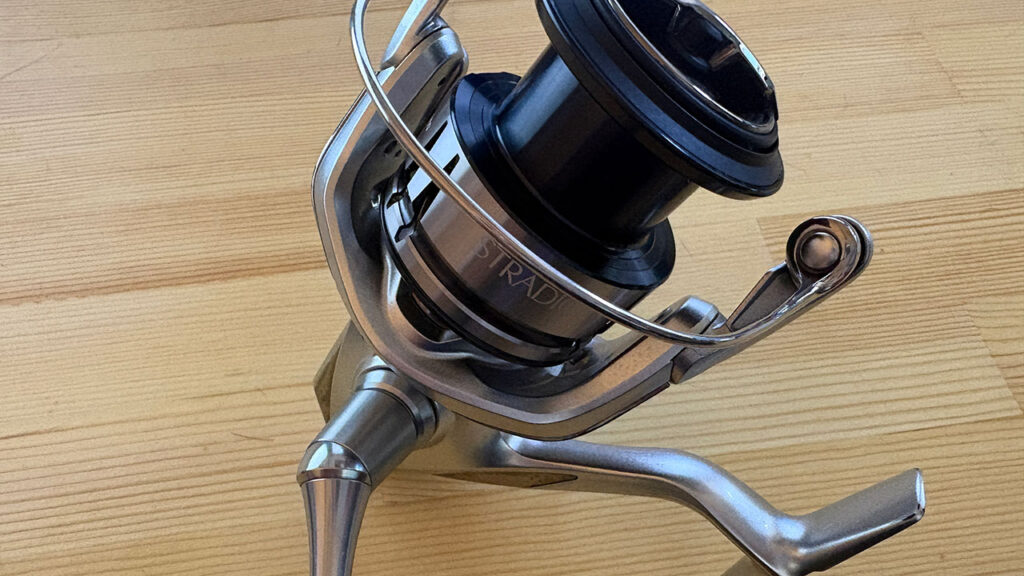
It’s the mid-tier “Stradic” (marketed as the “Stradic FM” in the US). American anglers position the Stradic as the absolute benchmark when evaluating other companies’ products. Why do they intentionally choose a practical mid-range model?
This time, let’s explore the extraordinary greatness of the Stradic reel, revealed through real evaluations from the North American market, and consider its positioning in Japan together.
The Crucial Difference Between Japanese and American Anglers
Through my research, I realized there is a crucial difference between Japanese and American anglers.
In Japan, there is a strong obsession with weight reduction and a yearning for high-end models, which often leads to the Stradic being unfairly underrated as a “heavy” or “cheap” reel. On the other hand, American anglers prioritize on-site reliability over vanity, purely valuing toughness. This focus on practicality is a major difference.
I am one of them, but some people say they can “drink while admiring their reels (though I don’t drink, lol).” I, too, felt the beauty of the form and the winding feel when I first held a Stella. However, in the tough-use environment of the US, durability is the absolute priority. Their approach involves spooling thick lines and going head-to-head with fish aggressively.
Let’s organize the differences in the mindset towards fishing between Japan and the US more deeply.
- Japanese Fishing Culture: Surrounded by the sea on all sides, there is a strong consciousness that fish is a valuable protein source, something easily caught and eaten (an extension of commercial fishing). This is backed by an agrarian and fishing culture where fields are cultivated and fish are easily caught in the sea.
- American Fishing Culture: A hunting culture (frontier spirit) and the concept of sports (game) form the foundation. This cultural difference is influenced by the history of pioneering and surviving while hunting prey.
Overwhelmingly Strict American Regulations
American regulations are strict because the concept that “wildlife and natural resources are the property of the state and must be protected by everyone” is thoroughly enforced.
In the US, anglers are required to purchase a “fishing license” issued by each state to fish (finely categorized into annual, 1-day, 3-day, resident, non-resident, junior, senior, etc.). A system is established where these revenues are reinvested into nature conservation, fish stocking, and maintaining fishing grounds.
The monitoring system is also strict, with Game Wardens on patrol. Violations can result in hundreds to thousands of dollars in fines, confiscation of fishing gear, and in egregious cases, even the confiscation of cars or boats. Since saltwater fishing in Japan is generally free and accessible to anyone with a few exceptions, the difference in this management system is overwhelming. You could say that anglers pay resource management fees and protect the fish themselves.
The Difference in the “Vector” of Obsession
- American Obsession (Trophy and Process): The focus is directed towards the process of “how to catch a bigger fish” and “how to fish exactly according to one’s strategy.” Once the goal is achieved, it is standard practice to pay respect to the fish and release it.
- Japanese Obsession (Catch Rate and Food): There is a strong tendency to focus on “how to catch as many as possible” and “how to bring them back deliciously.” Influenced by a food-oriented culture that includes techniques like humane dispatch and nerve spiking, the criteria for evaluating tools tend to become more complex.
Absolute Trust as a “Workhorse” Built for Harsh Environments
American fishing is massive in scale, and the environments are harsh. Anglers forcefully drag bass out of heavy cover and face monster-like targets that exhibit intense pulling power in coastal areas.
In such unforgiving environments, the Stradic is consistently praised by specialized media in North America as a “workhorse capable of withstanding extreme use.”
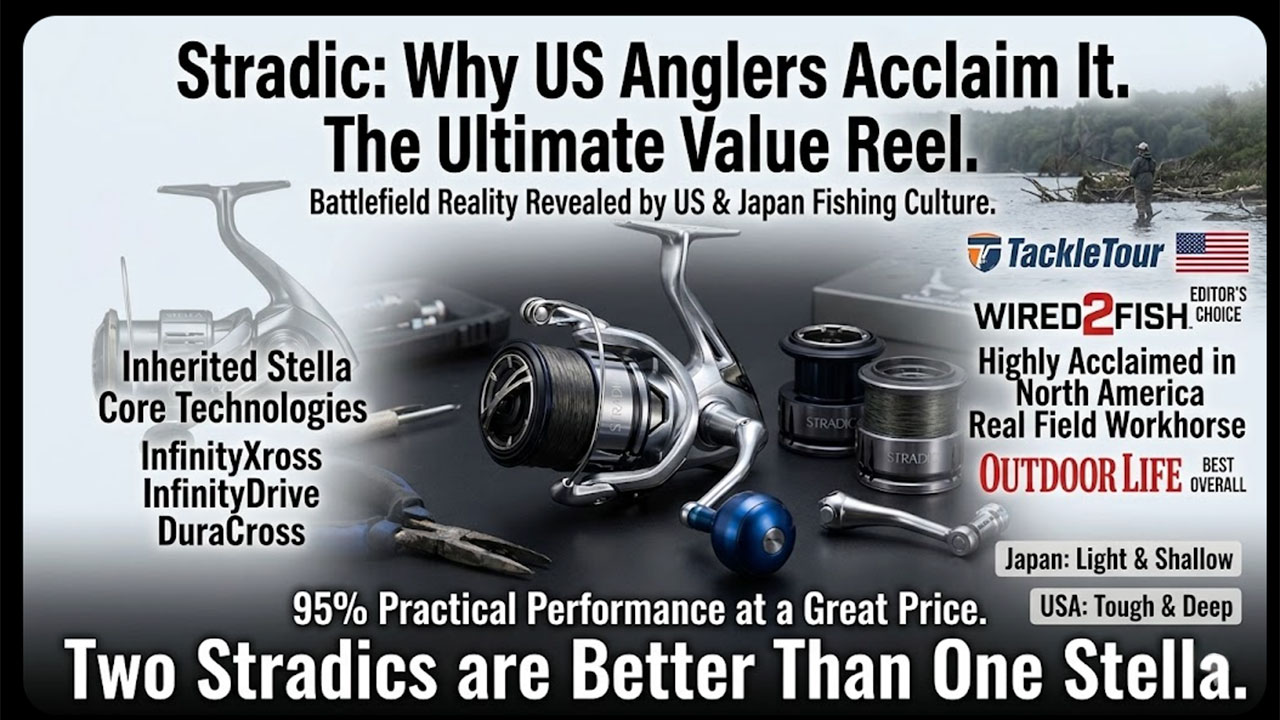
- TackleTour (North America’s Premier Tackle Review) Having conducted exhaustive reviews over the past few decades, they define the Stradic as the absolute benchmark, the “long-standing workhorse in Shimano’s spinning lineup.” They awarded the latest FM model the Editor’s Choice, clearly stating it “moves closer to Stella.”
- Wired2Fish (Core Media for Pro Anglers) Conducted thorough field tests. They highly praised the InfinityDrive and the newly designed drag system, concluding it is a “top-tier choice you can use on the water with absolute confidence.”
- Outdoor Life (Traditional Comprehensive Outdoor Magazine) Won the “Best Overall” award in grueling field tests spanning several months. It received high praise stating, “The HAGANE gear and frame show zero signs of degradation.”
Inheriting Stella’s Tech! The “Astounding Cost Performance” at About 1/4 the Price
The biggest reason American anglers actively choose the Stradic isn’t simply because they want to save money. They possess an extremely rational and pragmatic economic sense.
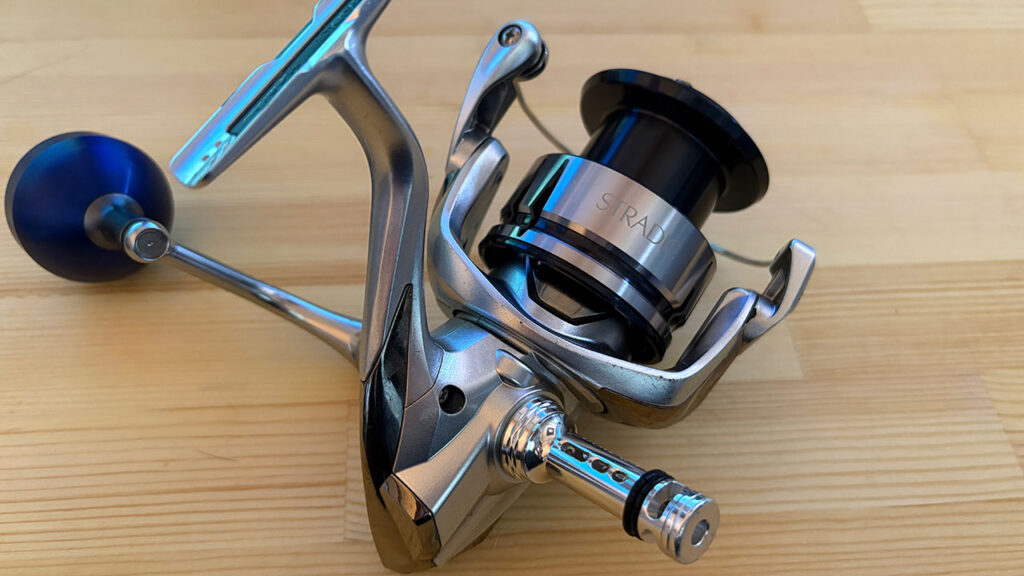
Shimano employs a development process called “trickle-down,” where innovative technologies first introduced in their flagship Stella are passed down to lower-tier models over time. Looking inside the latest ’23 Stradic, it’s nothing short of a “Stella Jr.”
Core technologies that were exclusive to the Stella just a year ago have been generously poured into it—such as InfinityXross, which dramatically improves gear durability; InfinityDrive, which achieves an extremely light winding torque even under heavy loads; and DuraCross, boasting 10 times the drag durability of previous materials.
Pay 80,000 Yen for the Remaining 5% Romance, or Get 95% Practicality for the 20,000 Yen Range?
In tackle design, the law of diminishing returns applies: once a certain performance level is reached, achieving minor improvements beyond that incurs enormous costs. A Stradic in the 20,000 yen range perfectly fulfills over 95% of the practical and functional requirements for catching fish.
To acquire that remaining sub-5% realm—such as dead-silent rotational smoothness—anglers invest tens of thousands of yen more to buy a Stella. The Stella certainly offers a wonderful experience, but that is not what definitively dictates your catch rate.
Securing the vast majority of Stella’s core performance with an investment in the 20,000 yen range. This is the smartest, most optimal answer derived by veteran American anglers.
America’s Unique Fishing Style and Rational Economic Sense
North American Power Fishing: Facing Big Fish with Deep Spools
Because the required tackle specifications differ based on fishing environments and targets, the reel “lineups” offered in Japan and the US (JDM and USDM) are distinctly different.
Japanese lure fishing is highly refined and often utilizes ultra-fine PE (braided) lines. Therefore, “shallow spool models,” which eliminate the need for unnecessary backing line, are abundant in the lineup and highly preferred.
In contrast, the mainstream in the US involves extracting bass from heavy cover or targeting heavyweight fish in vast lakes and coastal areas. As a result, “normal spools (deep spools),” capable of holding massive amounts of thick monofilament or heavy-pound PE lines, are selected as the standard lineup.
The cold-forged HAGANE gear and flex-free high-rigidity body of the Stradic perfectly mesh with this uniquely American style of “forcefully subduing big fish with thick lines.”
[Insert image here: Close-up of a deep-spool Stradic spooled with thick line and a lure]
The Tactical Advantage of Two Stradics Over One Stella
Here, allow me to make a highly practical suggestion for anglers seeking maximum catch results on a limited budget.
If you clutch your hard-earned 80,000 yen to buy one Stella, versus buying two Stradics in the 20,000 yen range and using them strategically—which do you think will directly translate to a better catch rate?
To cut to the chase, it is overwhelmingly the latter.
This is because, in fields where you face nature, “adaptability to conditions” and “immediate response to trouble” dictate your catch rate far more directly than the minute winding feel of a reel. Specifically, the advantages gained by strategically operating two Stradics (or one reel plus multiple spare spools) can be summarized into the following three points.
- Instant Strategic Changes (Gear Ratio and Line Rotation) For example, spool one high-gear (XG) reel with PE #1 to #1.2 for cherry salmon or regular salmon casting games. Spool the other normal-gear reel with PE #0.6 to #0.8 for light game fishing like light eging or Atka mackerel. A normal gear excels when delicately enticing salmon with dead-slow float lures, but if it lacks drag power, you can instantly adapt by switching to the “spare spool” of a C3000XG.
- “Immediate Recovery” from Fatal Line Trouble Imagine encountering a snag or a break-off during the prime time of dawn/dusk that you absolutely don’t want to miss… If you only have one Stella, you’ll be forced to tie a new line system in the dark or wind, resulting in a massive time loss. However, if you have a backup Stradic (or a spare spool with the leader already tied), you can return to the front lines in seconds.
- “Transformational” Settings Leveraging Spool Compatibility Shimano reels offer spool compatibility within the same body size (e.g., 2500S and C3000XG). As mentioned above, attaching a C3000XG spool to a 2500S body not only increases line capacity but also instantly bumps the maximum drag power from 4kg to 9kg. Your light-game reel instantly “transforms” into a big-game spec.
Conclusion: Engage with Fish to the Fullest Using the Best Tackle
As American anglers have proven, the Stradic is a “workhorse” that truly shines when used robustly in harsh environments. Maximize its potential to the limit by rotating multiple units or utilizing spare spools.
Rather than timidly using an 80,000 yen Stella for fear of scratching it, aggressively utilizing a Stradic in the 20,000 yen range—which inherits Stella’s core technologies—to suit field conditions is the key. This is arguably the smartest, most realistic optimal solution for anglers looking to encounter as many fish as possible within limited budgets and time.
The recreational activity of fishing is an intellectual game of how to engage with the unpredictable opponent that is nature. You aren’t choosing it as a compromise because of a lack of budget. It is the smartest, most reliable partner for strategizing and conquering situations while getting muddy on the front lines.
If you’re pondering over tackle for your next fishing trip, please consider this aggressive option of “operating multiple Stradics.” An overwhelmingly broader scope of fishing and solid catch results should be waiting for you.
If you want to elevate the excitement and tactical nature of fishing to the absolute limit, owning two reliable workhorses is the strongest choice, rather than entrusting everything to a single flagship model.
Pack your best tackle into the car, and let’s go engage with the fish to the fullest on your next day off!
Q
Why do American anglers rate the Stradic higher than the flagship Stella model?
A
This is because in the US, on-site “toughness (practicality)” is purely valued over “vanity.” American fishing environments are harsh, and the mainstream style involves using thick lines to forcefully drag out big fish. Therefore, the Stradic commands absolute trust as a highly rigid workhorse capable of surviving extreme use.
Q
Won’t choosing the cheaper Stradic mean compromising on performance?
A
It does not result in a performance compromise in actual fishing. This is because Stella’s core technologies are inherited. Shimano has a “trickle-down” process where technology from higher-end models trickles down to lower-end ones, and the latest Stradic is infused with former Stella privileges like InfinityDrive and DuraCross. It boasts astounding cost performance, perfectly satisfying over 95% of practical functions for the 20,000 yen range.
Q
To increase catch rates on a limited budget, should I buy one 80,000 yen high-end reel or two mid-range reels in the 20,000 yen range?
A
Overwhelmingly, owning two mid-range reels (Stradics) or operating with “spare spools” is recommended. The adaptability to instantly rotate gear ratios and line thicknesses, and the immediate responsiveness to return to the front lines with another reel (or spool) even if line troubles like break-offs occur, bring a “tactical advantage” that directly impacts your catch rate far more than a reel’s minute winding feel.
[Reference & Citation Media] The reviews and evaluations of the “Stradic FM” (Domestic Japanese name: 23 Stradic) from major American fishing media introduced in this article can be viewed via the links below (*All are English websites).
- TackleTour North America’s premier tackle review site. Evaluated as a mainstay reel closing in on the Stella.
Article Name: Shimano’s Stradic Moves Closer to Stella in Major Refresh
URL: http://www.tackletour.net/viewtopic.php?t=89797 - Wired2Fish Core media referenced by pro anglers. Highly praised for its absolute reliability in the field.
Article Name: Shimano Stradic FM Review
URL: https://www.wired2fish.com/tackle-reviews/shimano-stradic-fm-review - Outdoor Life Traditional comprehensive outdoor magazine. Won Best Overall in grueling coastal tests.
Article Name: The Best Inshore Spinning Reels, Tested and Reviewed
URL: https://www.outdoorlife.com/gear/best-inshore-spinning-reels/